As system integrator Bright IA was developing an automated work cell for a metal fabrication process, they decided to partner with Valin to support the mechanical infrastructure and safety systems required for the project. The goal of the automation initiative was to improve production efficiency while addressing labor challenges in a demanding manufacturing environment. By combining flexible structural design, safety infrastructure, and hands-on installation support, Valin helped Bright IA successfully deploy a robotic work cell that significantly increased production throughput while improving safety for operators.
Manufacturing Challenges
The application centered on producing metal fenders used for trailers. In the existing process, operators manually fed metal plates into a press brake and removed them after processing. This manual workflow created two major challenges for the manufacturer. First, the plant struggled to recruit and retain operators for the physically demanding work. Second, the company wanted to increase production without increasing headcount. Automation offered a way to address both issues simultaneously.
Bright IA designed an automated system using robotics to load and unload parts from the press brake. However, implementing the system required supporting mechanical infrastructure that could integrate new automation technology with existing equipment.
Integrating Automation
The press brake being used in the project was an older machine that had not been designed with modern automation in mind. Surfaces were uneven, the surrounding floor was rough, and the physical footprint around the equipment was extremely tight. Successfully integrating the automation system required adaptable structures and the ability to make adjustments during installation.
Valin supported the project by designing and building the structural framework required for the system’s conveyors and safety guarding. Bright IA specified the use of three timing belt conveyors to move metal plates into and out of the press brake. Based on general dimensional parameters provided by Bright IA, Valin designed custom frames to support the conveyors and fit within the limited space available around the press brake. The team worked through several design revisions before fabrication and ultimately delivered the completed structures to the facility.
To read the full case study, click the link below:
Bright IA Featured by FANUC America in “Get It Done” Series
We’re thrilled to share some exciting news! Bright IA was recently featured by FANUC America Corporation on their official YouTube channel as part of their popular series, “Get It Done.” This recognition highlights our commitment to innovation and excellence in automation.
In the featured episode, we showcased an application built using the FANUC CRX-10iA collaborative robot. Our goal was clear: deliver a highly efficient solution while maintaining a cycle time under 10 seconds—and we did just that!
This project demonstrates how collaborative robotics can combine speed, precision, and safety to meet demanding production requirements. By leveraging FANUC’s advanced technology and our expertise in automation, we created a system that not only meets performance goals but also enhances flexibility and ease of use for operators.
Technical Breakdown
FANUC CRX-10iA cobot
6‑axis, 10 kg payload, 1,249 mm reach
Drag-and-drop touchscreen programming and hand-guided teaching
8 years zero-maintenance, ISO 10218‑1 cert., built‑in force sensing
Multi‑machine tending cell:
Handles adhesive and caulking cartridges across four process stations
Picks empty cartridges, verifies orientation via vision system, loads into filler, then routes filled cartridges to the appropriate capping station or drawer based on SKU via HMI
Cycle time performance:
Maintains sub‑10‑second cycle time per cartridge, meeting or exceeding existing benchmarks
A huge thank you to FANUC America for featuring Bright IA, and kudos to our team for designing, programming, assembling, and commissioning this high-performance application. We’re proud to demonstrate how collaborative robots, vision-guided automation, and machine tending can deliver industrial-speed results with unmatched flexibility and safety.
Bright IA founder and automation expert Davide Pascucci was recently featured on the Manufacturing Hub Podcast, a leading platform for industrial automation professionals. In this episode, Davide shared valuable insights on automation strategies, robotics integration, and how data-driven manufacturing is shaping the future of production.
How Bright IA helps manufacturers implement scalable automation and robotics solutions.
Best practices for robotics integration in existing production environments.
The role of data analytics in improving efficiency and reducing downtime.
Why collaboration and community are essential for driving innovation in Texas and beyond.
Davide emphasized the importance of integrating robotics seamlessly into manufacturing workflows, ensuring flexibility and adaptability for future growth. His approach focuses on empowering end-users to do more with automation.
If you’re looking to integrate robotics, automate workflows, or leverage data-driven solutions, Bright IA can help. Contact us today to discuss your automation goals and discover how we can make your operations smarter, faster, and more efficient.
Vision Podcast #010 – Integrating AI and Robotics w/ Bright IA & Aether Advanced Tech
We were honored to be invited to speak at episode number #10 of MVPRO MEDIA – Machine Vision & Image Processing – THE PODCAST with Josh Eastburn!
In this episode,
Josh talks with a Texan SI partnership bringing cutting-edge AI/ML-based vision to manufacturing automation.
Davide Pascucci of Bright IA and Eric Smith of Aether Advanced Technology discuss the role of AI in enhancing traditional defect detection, as well as its limitations.
how to identify a fake, and the need for incremental approaches and collaboration in problem-solving.
If you want to listen to the podcast or check the transcript, please click on the link below:
Our very own Davide Pascucci joined Tony from Timpl on his podcast to discuss the Industrial Automation and Robotics revolution. Check it out HERE.
Last week, we participated in another amazing podcast hosted by Tony Moore, where we discussed industrial automation and robotics, the state of manufacturing, and humanoids.
1769-AENTR front view Details of production date (bottom right corner) I thought this last week was going to be quite easier or slowing down a lil bit…never mind… I’ve been in 3 different places, but on one in particular, where we have recently performed an upgrade, the system IS giving problems, the outputs are holding the last value even though the cards setup are the opposite.
The only way to reset the system is by power cycling the entire panel. All the symptoms were pointing to a faulty module.
Since I couldn’t be present at the times this event is happening (and it would do this randomly every 2-3 days), I decided to put a trap and log the faults of the adapter 1769-AENTR where all the outputs are connected, I discovered that the module is faulting out and throwing the following: 1769-AENT may exhibit the following fault hex #00204 (516 decimal) It is a known issue by Rockwell Automation So, if you have a module with production dates within Feb 2nd 2021 and Aug 25th 2022 you should ask for a replacement.
I hope this post help someone save some time and headaches in troubleshooting! Also,
digital transformation, taxes, advantage, innovation, automation, MES, integration, robotics
As a business owner, I am always looking at ways to improve and innovate my systems and work efficiently with the tax code.
But recently, I was thinking if there were ways to help my clients do the same, through the services that I am providing to them (absolutely not taxes services!)
By reading some articles here and there, and getting a better knowledge of the R&D tax (research and development), I figured that this advantage could be easily applied to my industry, which is industrial automation and manufacturing.
So, I started writing down some sentences on how to approach my clients with this idea, and here are some that I’d like to share with you
Isn’t true that everyone in the industry has heard or discussed how to innovate, renovate, or improve a machine/process/production of some sort?
Ok, along the discussion, haven’t you thought about what variables, people, materials, and planning would involve doing something like the listed above?
For instance, everyone can tell you about the technical aspect and just focus on it and how different ideas or concepts can accomplish what you are requesting, isn’t that true?
But, what if I tell you that with the technical aspect we can also put together a plan of action, that will help you get back your investment for free by potentially writing off the entire project, doesn’t that sound good?
(Again, we are NOT financial advisors here, I suggest you always check with your CPA or attorney, also not all the projects will apply, but line retrofits, improvements such as adding a robot, etc)
Check this link to know more about what the IRS is allowing under Section 179 here:
Well, the plan I am talking about here is structured as follows:
Find out how much Investment to accomplish one or more tasks or challenges listed at the beginning (let’s say initial conversation)
We will work with your CPA or accountant to find creative ways to reduce your taxes through R&D
Targeted ROI showing how long it would take for the system to pay for itself
How does this sound so far? Good?
Alright, as you can see, we are trying to go above and beyond our client’s expectations, because we understand that a lot of aspects need to take place before you can make a decision.
We are people helping people achieve their maximum potential without breaking the bank or postponing the improvement for lack of approval (this part particularly applies in the corporate world)
If this sounds too good to be true, I encourage you to think twice, because it’s easy math, and the IRS code is right there for everyone to read, won’t you agree with that?
Do you think this model, with some tweaks, could be applied across different industries? I believe so, but I would like to receive your
feedback.
Takeaways
I think it is worth verifying these scenarios, as you always looking to cut costs and improve production, is good to do this exercise for free and discover if advantages are available for your projects.
Conclusions
Sometimes we give too much emphasis to what we know best, but the duty of a leader is always to look 5+ steps ahead, and combine different ideas/tactics to be at the edge in every scenario (at least, try to be…).
The point here is to get informed, build partnerships, and strategize with your group to find solutions that ultimately can improve our lives.
I hope you enjoyed this quick reading, let me know what you think.
It took quite a bit 😅 to come back and write to our blog, but here we are with another real application and case study.
As our logo states “simplified automation”, for us is not just a marketing slogan but instead is our belief, keep it simple, keep it smooth.
This is the case for this application where we were tasked to make talk a ControlLogix with a pH controller.
As a lot of you know, the most famous and used communication protocol is Modbus, and most of these specialty devices can communicate over Modbus.
But what we were thought to always do, in the case we had to pass information from/to Allen Bradley and other devices via Modbus TCP, was to purchase a piece of equipment such as Redlion or Anybus and use it as a protocol converter.
But a few years ago, Rockwell released this add-on instruction that allows implementing the Modbus protocol to the Ethernet/IP communication. While the first release was a little bit tricky, the latest has been dramatically improved, this resulted in the fastest solution deployment.
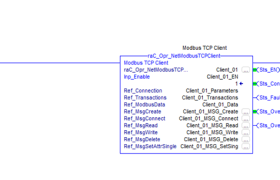
Screenshot of the add-ons instruction
After watching one of the Tim Wilborne from TW controls videos, an opportunity just came to happen to use the AOI, and we did it successfully.
As always, you must deal with offsets, pulling rates, and end devices setup, but other than that, we were able to use both read and write commands and control the device (in our case a Walchem W600 pH controller) from the HMI.
Some setups need to happen, to be able to make this work:
Make sure to place your Modbus add-ons on a subroutine that run at 20 ms periodically
2 – messages can overlap with each other, while we did not experience any loss of data, is always a good practice to set different pulling rates, play with the numbers until the “overlap” bit will go away.
3 – Put the tags you are using to communicate with the HMI on a lower scan routine, this is another good practice, since we are using fast scanning, we want just the Modbus communication to sit in there, while the tags and other manipulation (i.e., 2 words to float), will stay on a slower scanning task.
4 – If You can’t connect with your setup at the first attempt, it’s always good to have in your toolbox software such as Modbus poll and verify that the famous port 502 is enabled via telnet.
Something that we did not mention earlier is that the AOI has the server and the client version, in our scenario we used the client mode, but we do think it would make too much difference to integrate by using the server function.
In conclusion, we are pleased to have found this awesome solution, especially with so many issues we are experiencing with the supply chain, and how difficult is to find devices, this is a great and cost-effective solution to get the customer up and running in little time. Who isn’t for a simplified and quick solution?
As always, we are here to help, if you need any support on this or other related matters, contact us, or drop a comment below, we’d like to talk about this stuff all day long.
My name is Davide, I am the Chief Automation helper at Bright IIOT, and today we are going to discuss current and hot topics. Share with me 5 minutes of your time.
The Factory’s maintenance, operation management are recently struggling with the following obstacles:
Shortage of workforce
Equipment renovation
Demand and supply = throughput
But the question is, where to start or how to overcome at least one of the obstacles?
Shortage of Workforce
We all know that after these struggling times, it’s difficult to find and hire talents or attract them to come back to the market.
Let’s pretend that these people will work in your production lines, processes that are already in your plant/plants, but in this case, they are not available or you could not find any candidate willing to work with you.
The first question to ask is: in your existing process, which involves automation and automated equipment, is there anything that could be IMPROVED, manipulated, updated that could remove some manual operation or intervention?
Think about repetitive operations such as adjusting parameters each time some events happen, moving material from point A to point B, writing down reports, or needing to historize and mine data? Calculate how efficient is your process.
All of these things and more can be automated and let the workforce, you were able to keep with you, focus on dynamic tasks that really require human intervention. This is the aid of automation.
Machine and equipment renovation
I am going to change the tone here as I am pretty sure you have machines and equipment that you give constant maintenance and cleaning to keep them ready and precise for the next task.
The same applies to the automation that lets these machines run and operate in everyday tasks.
The automation devices will deteriorate over time and they are not reliable anymore, especially old PLC with EEPROM memories.
But more than that, it also depends on where these devices operate, is the control panel installed in a too hot, too cold, too acid environment?
Also, do you have backup copies of your source codes, spare batteries for the memory, spare I/O cards, power supplies, etc.?
Do you have old relay logic panels that you would like to improve and maybe modify the logic to accommodate another product, another function, etc.?
In other words, can you afford to stay down for more than 30 minutes in your plant? If the answer is NO, then you should lay down a maintenance plan and eventually retrofit your automation and improve exponentially the reliability.
As we are well known, the demand surged in the last months and no sight is going to normalize anytime soon.
My question is, what actions are you taking to keep up with these orders requests?
Is automation the right answer to the problem?
Probably yes, even though our industry is affected by the supply chain crisis, we can always utilize the hardware that is available in the market by selecting and mixing several manufacturers or going to find refurbished parts. Either way is possible.
With that being said, is the duty of the end-user to identify his/her system bottlenecks and unclog them with targeted actions which could intervene in the existing systems and add a couple of sensors or cameras or robot arms or could automate a line. The sky is the limit,
But more importantly, to be able to track the changes applied to the processes, the end-user should implement a metric system that will monitor and report each process, each machine, and also the overall plant efficiency.
This exercise is not only beneficial for high-rank corporate people but For the plant floor personnel as well, where they can constantly and real-time monitor the performance and reliability of every single machine. The OEE (Overall Equipment Effectiveness) and MES (Machine Execution System) are the two methods widely used in our industry.
In conclusion, as we said earlier, the sky is the limit, but you need to start somewhere if you want to keep with the competitors and stay on the edge of the innovation.
The technologies are moving faster than ever, and if you are a company that wants to stay in the game for a long time and want to be profitable and pay and treat your employees well, then you cannot afford not to take massive actions.
The digital transformation is here, and few companies are starting to realize that is time to make the next move, don’t be the majority that is sitting there and think that things will stay the same as 20 years ago.
If you are interested in talking FREELY about these topics, contact me, I would love to hear your feedback.
Thank you,
Davide @ Bright IIOT
“Changing the automation industry one signal at the time.”
Interested in the world of digital transformation? Ready to discover how Industry 4.0 is taking the globe by storm? Luckily for you, you’re in the right place. In this blog, you can expect to discover all of the latest news, updates, and thought-pieces from Bright IIoT.
Stay tuned and get in touch if you have any questions about our offering.
To provide the best experiences, we use technologies like cookies to store and/or access device information. Consenting to these technologies will allow us to process data such as browsing behavior or unique IDs on this site. Not consenting or withdrawing consent, may adversely affect certain features and functions.
Functional Always active
The technical storage or access is strictly necessary for the legitimate purpose of enabling the use of a specific service explicitly requested by the subscriber or user, or for the sole purpose of carrying out the transmission of a communication over an electronic communications network.
Preferences
The technical storage or access is necessary for the legitimate purpose of storing preferences that are not requested by the subscriber or user.
Statistics
The technical storage or access that is used exclusively for statistical purposes.The technical storage or access that is used exclusively for anonymous statistical purposes. Without a subpoena, voluntary compliance on the part of your Internet Service Provider, or additional records from a third party, information stored or retrieved for this purpose alone cannot usually be used to identify you.
Marketing
The technical storage or access is required to create user profiles to send advertising, or to track the user on a website or across several websites for similar marketing purposes.